Active Threat Response Corporate Training: What Every Team Needs to Know
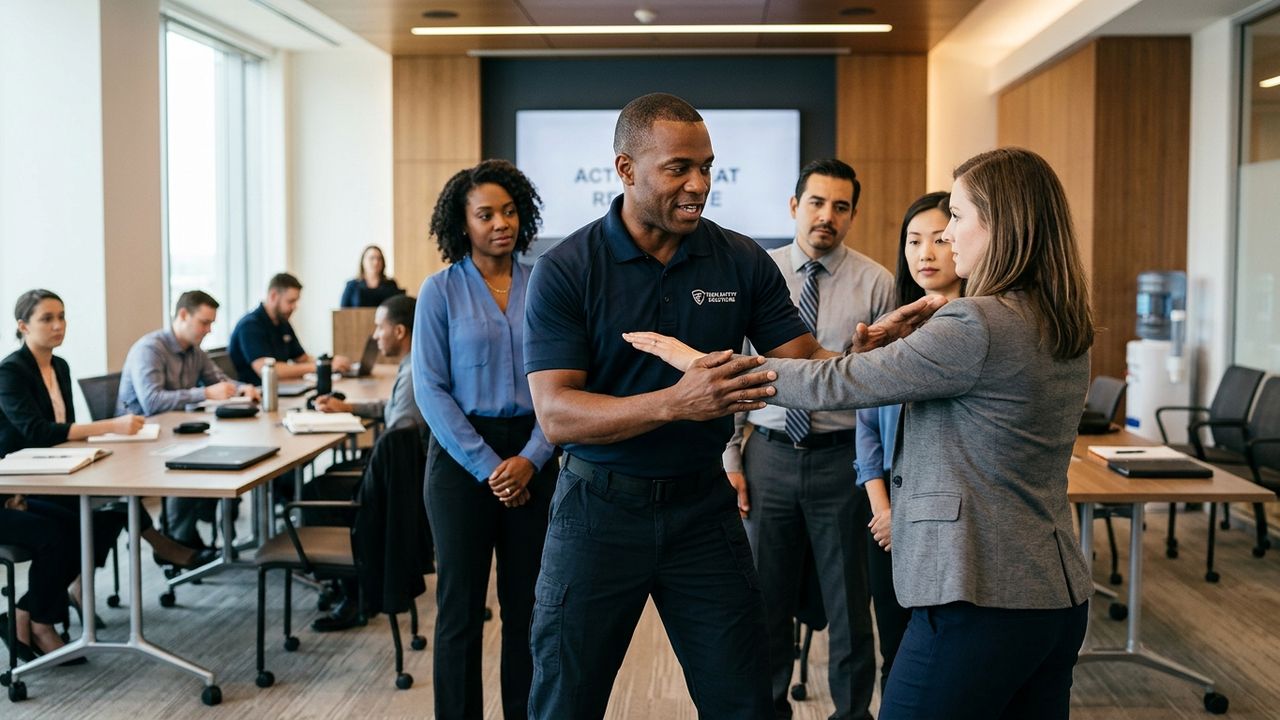
Active threat response corporate training gives your team a practiced, structured way to react when seconds count. Rather than freezing or waiting for instructions, trained employees know how to assess, decide, and act. We bring this training directly to your workplace, building skills that are immediately relevant to your specific environment and team.
Why Corporate Teams Cannot Afford to Skip This Training
Workplace violence is not a rare edge case. According to the FBI's ongoing research into active shooter incidents in the United States, businesses and office environments consistently rank among the most common locations where these events occur. The Occupational Safety and Health Administration (OSHA) also recognizes workplace violence as a serious occupational hazard, noting that it affects millions of workers across industries every year.
Most organizations have a fire evacuation plan, regular drills, and posted exit routes. Very few have given their teams the same level of preparation for a human threat. That gap is exactly what we address. We work with corporate clients to close the distance between policy and practice, turning written emergency plans into physical, rehearsed responses.
What Does Our Active Threat Response Training Actually Cover?
We structure our corporate sessions around three core areas: threat recognition, decision-making under stress, and physical response skills. Each area builds on the last, so your team finishes the session with a connected, usable framework rather than a list of disconnected tips.
Threat recognition covers environmental awareness, behavioral indicators, and how to trust your instincts without overreacting. Decision-making under stress addresses the psychological reality of an active threat, including how adrenaline affects judgment and how to short-circuit panic with a pre-rehearsed action plan. Physical response skills draw from our defensive tactics curriculum, rooted in IKI-certified instruction, and include techniques for creating distance, improvising barriers, and, when there is no other option, defending yourself and others at close range. You can learn more about the full scope of what we teach on our Defensive Tactics service page.
What Should a Team Do in the First 60 Seconds of an Active Threat?
The first minute is where outcomes are shaped. Untrained individuals often spend that time waiting for confirmation, looking to others for cues, or trying to process what is happening. Trained individuals move. They assess their immediate environment, choose the best available option from a run, hide, or fight framework, and they act on that choice without hesitation.
We walk every team through realistic scenario work so that the decision-making process becomes automatic. We also address team dynamics, because in a corporate setting, people look to colleagues and managers for signals. We help leaders understand their role in those first critical moments, and we help every team member feel capable of acting independently if they need to.
De-escalation as a First Line of Defense
Physical response skills matter, but the best outcome is always one where a situation never escalates to violence. We integrate verbal de-escalation and conflict communication into our corporate training because many workplace threats begin with a pattern of escalating behavior that can be interrupted before it becomes a crisis.
We teach teams how to recognize warning signs, how to communicate calmly under pressure, and how to involve the right people early. These are general workplace safety skills that benefit every employee, from front desk staff to senior leadership. De-escalation is not a soft skill. It is a tactical one, and we treat it that way.
How Is Our Training Different from a Standard Safety Seminar?
Most safety seminars are passive. Someone stands at the front of a room, walks through a slide deck, and your team leaves with a handout. We do not operate that way. Our sessions are hands-on from the start. We use your actual workspace, your real hallways and conference rooms and entry points, to make the training as relevant as possible.
Our lead instructor brings IKI Certified Instructor credentials and Monadnock Defensive Tactics Instructor certification to every session, which means the physical training is both tactically sound and designed with participant safety and physical accessibility in mind. We adapt our delivery to your team's size, fitness level, and the specific risks relevant to your industry. No two corporate sessions look exactly the same, because no two workplaces are exactly the same.
Who Should Attend Active Threat Response Training?
The short answer is everyone. Active threat response training is not just for HR managers or executive protection teams. It is for the receptionist who is often the first person a visitor encounters. It is for the warehouse team working in an isolated area. It is for the office manager who is responsible for headcounts during an evacuation. Threat preparedness is a whole-organization skill.
We also work with law enforcement professionals looking to supplement their existing training with additional hands-on skill-building. While our sessions do not carry accredited continuing education or POST certification hours, they offer practical, scenario-based practice that complements formal agency training programs.
Bring This Training to Your Team
We are a mobile training operation, which means we come to you. We serve corporate teams throughout Greater New Orleans and southeastern Louisiana, bringing professional active threat response training directly to your facility. There is no need to coordinate off-site logistics or pull your team away from their environment. We work in your space, on your schedule. [Reach out today](https://incendiarytrainingservices.com/contact) to talk through your team's needs and find out how we can build a session that fits your organization.