De-Escalation Techniques Every Security Officer Should Know
This post is part of our De-Escalation training resources.
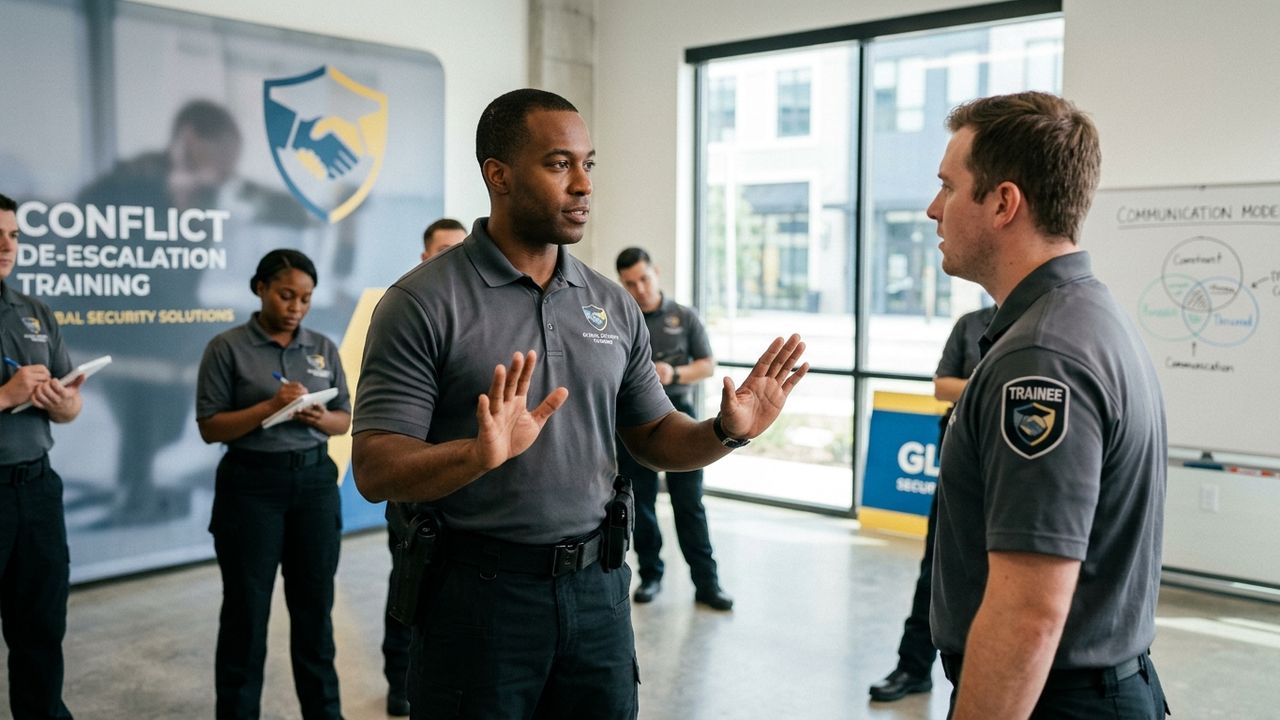
The most effective security professionals resolve the majority of confrontations without ever laying hands on anyone. Verbal communication, body language, spatial awareness, and tone control are the tools that do most of the work. When those skills are trained and practiced, physical intervention becomes a last resort rather than a first response.
Why De-Escalation Is a Core Skill, Not a Soft Skill
There is a persistent misconception that de-escalation is somehow less serious than physical training. We push back on that directly. OSHA recognizes workplace violence as a significant occupational hazard, and their guidance consistently points to early intervention and communication training as primary prevention strategies. The ability to read a situation, control your own emotional state, and guide an agitated person toward calm is a high-level skill that takes real instruction and repetition to develop.
We build our de-escalation curriculum around practical, scenario-based training because reading about techniques and actually executing them under simulated stress are two very different experiences. If you want to see exactly what we cover, take a look at our de-escalation training services page for a full breakdown of what we offer.
What Does Effective De-Escalation Actually Look Like in Practice?
Effective de-escalation is not about being passive or backing down. It is about being deliberate. Here are the core techniques we train with every team:
Tone and pace control: The way something is said carries as much weight as the words themselves. A calm, measured voice signals control. Matching an agitated person's volume or speed escalates the situation. We train people to slow down their speech intentionally, even when their own adrenaline is spiking.
Spatial positioning: Where you stand relative to an agitated person matters. Standing directly in front of someone can feel confrontational. A slight offset, maintaining a safe reactionary gap, and keeping your body language open rather than squared up can reduce perceived threat and give both parties room to breathe.
Active listening and validation: People in crisis want to feel heard. Acknowledging someone's frustration without agreeing with their behavior is a skill. Phrases that reflect understanding without conceding authority can shift the dynamic quickly. We role-play these exchanges repeatedly so they become natural under pressure.
Limiting commands and offering choices: Issuing rapid-fire commands to someone who is already overwhelmed tends to produce resistance. Offering limited, clear choices gives the person a sense of agency and reduces the likelihood of a power struggle. This is a small adjustment that produces measurable results.
Reading Pre-Incident Indicators Before a Situation Develops
De-escalation does not begin when someone is already yelling. It begins the moment you notice that something is off. We train teams to recognize behavioral pre-incident indicators: changes in posture, furtive movement, target glancing, clenched hands, and elevated breathing. Catching these signals early gives you more time and more options. By the time a situation becomes loud and physical, your window for easy resolution has already narrowed significantly.
Situational awareness is not paranoia. It is a trained habit of attention. We teach people to scan their environment systematically, identify anomalies without fixating on them, and position themselves to maintain visibility and options. This is the foundation that makes every other de-escalation technique more effective.
What Happens When De-Escalation Is Not Enough?
Verbal skills resolve most situations. But not all of them. Part of what makes our training different is that we do not treat de-escalation as a standalone module disconnected from physical reality. We train people to understand the full spectrum of a confrontation, from first verbal contact through the point where physical intervention may become necessary. Knowing that you have physical skills in reserve actually makes your verbal de-escalation more confident and more effective. Composure under pressure is easier when you are not afraid of what happens if the conversation fails.
Our instructors hold an IKI (Israeli Krav International) Certified Instructor credential, Brazilian Black Belt credential, Monadnock Defensive Tactics (MDTS) Instructor credential, and a Personal Trainer certification.
Tailoring De-Escalation Training for Workplace Teams
We work with corporate teams, law enforcement, and professionals across a wide range of industries. The specific language, scenarios, and environmental factors we train for are different for a retail team than they are for a hospital staff or a corporate office. We customize our sessions to reflect the actual situations your team is likely to face, not generic examples that feel disconnected from daily work.
For law enforcement professionals, we offer supplemental skill-building in verbal control and de-escalation tactics that complement existing training. What we provide is practical, scenario-driven instruction designed to sharpen the skills your team already has and fill gaps that formal training may not cover in depth.
Bring De-Escalation Training to Your Team
We are a mobile training company, which means we come to you. We serve teams across Greater New Orleans and southeastern Louisiana, and we bring everything we need to your facility, your office, or your training space. There is no need to coordinate travel or rent a separate venue. If you are ready to build a team that can handle confrontation with skill and composure, [Reach out today](https://incendiarytrainingservices.com/contact) and let us put together a training plan that fits your team's environment and schedule.